The Schick Foundation has submitted the final requirements for getting approval from the FDA for Blue Green Algae. Final approval is expected from the FDA in 4 weeks. If it is approved it will be one of the first supplements or botanicals to have FDA approval for study. The Foundation has already developed a protocol for testing Blue Green Algae in HIV+ patients who are virologically suppressed by antiretroviral agents, preferably Atripla, and are treatment Naive except for beginning Atripla within the last 6 months.
The protocol might also help determine at what level of CD 4 count Blue green algae might be successful. The protocol is stratifying patients from CD 4 counts of 200-350, 350-500, and patients who have greater than 500 CD 4 counts/ml. The results of the study once started should take about 6 months, but the markers we are following, pro-viral DNA, viral load, CD 4 count, CD 4%, CD 8 count CD 8%, D-Dimer, C Reactive Protein, and others might give an indication of success much earlier than 6 months.
The Schick foundation had already gotten approval for presenting a poster at the large AMFAR meeting in New Orleans on :November 29. The meeting extends from November 28-December 1. The title of the original poster was The Role of APHANIZOMENON FLOS-ACQAE in treating HIV+ virologically suppressed patients with HAART:. The original submission was on 1 patient whom we term patient O. We continued to present updated material thru 14 weeks and as a result the poster was upgraded to a full presentation to this large meeting. The significant findings already show that we have found that APHANIZOMENON FLOS-ACQAE, abbreviated AFA or Blue green algae, statistically improved patient O's CD 4 count, and CD 4%, while other markers named above are stable. CD 34 was elevated showing that the product which increases the release of bone marrow stem cells from the person's bone marrow 30% 2 hours after ingestion of 1000 mg of the supplement is working. We expect to have more data especially with respect to how AFA might be working at the meeting in New Orleans.
The Schick Foundation has added 2 new members to their consultant staff. Dr. Annika Hylmo a PHD, and Dr. Michael Hamrell also a PHD give the foundation a greater presence in science, with one of these people, Dr. Hamrell, being previously associated with the FDA, and the NIH.
To see whether the protocols that the Schick Foundation has developed donate on line to the web sites www.schickfoundation.org or www.schickresearch.com . You could also submit a check to the Peter Schick Foundation at 1223 Wilshire Blvd.#1007, Santa Monica Ca., 90403. We are approaching the end of the year where people think about charitable donations and what better cause than to donate to a 501C3 foundation that has a chance to end the greatest pandemic in deaths since early times the world has seen.

How much does viral load need to fall to halve HIV transmission risk?

The partners in Prevention study of acyclovir as an HIV prevention measure showed that an average viral load reduction of .74 log is needed in order to reduce the risk of HIV transmission by 50%. The has important implications for future studies of HIV treatment as prevention.
This study though scant in data really hits the nail on the head. Microbicides, barrier protection for women, pre-exposure prophylaxis with antiretroviral drugs for those having unprotected sex have by and large failed as a preventative measure. Condoms and circumcision although successful are not particularly appealing to men having sex. HIV treatment as Prevention is the best way we believe of preventing the spread of HIV, especially in resource poor countries. In fact mathematical models in some provinces in Africa have shown that treating everyone could come close to stopping the spread of the infection in approximately 7/1/2 years. With no HIV preventative vaccine in sight, treatment as prevention may be the way to go.
The Schick Foundation Attended The AIDS Walk

The AIDS Walk
Board members Peter Schick and Arton Kabashi attended APLA's AIDS Walk on October l8,2009..This was the 25th anniversary of the AIDS walk. APLA has been the most successful fund raising organization mainly thru APLA and its generous sponsors such as MACY's. The day started out with a breakfast that Chairman of the Board Peter Schick attended. He listened to talks by various government and APLA officials including the Mayor of Los Angeles Antonoio Villaigarosa. This was followed by a celebrity introduction before a throng of at least 30,000 people, who amongst them were high school kids, collage kids, and people from all walks of life.
The goal of the 6.2 mile walk was 30,000 people walk to help 60,000 people infected with HIV in LA county.
People especially young people who are complacent about HIV in the USA, remember, at least 50,000 people are still infected in the USA each year, and an equivalent amount of people die of HIV/AIDS. There are at least 300,000 people walking around in the USA who are infected with the HIV virus and do not know it. We say get tested and if you test positive after a short period of time of counseling and talking to your partners or family start antiretroviral treatment. We have been advocating this for a long time The antiretroviral drugs available, are easier to take and have fewer side effects. Unchecked HIV is becoming a major health problem in this country being the cause of Cardiovascular problems, Liver problems, Kidney problems, and other organ system problems.
Our foundation wishes APLA well in the coming year, but if the AIDS walk is any indication they are in for a very good year.
The foundation is ready to present its second protocol and procedure for getting alpha sun for use as a supplement to HIV+ patients virologically suppressed who are on minimal antiretroviral medications. The pilot study being sent to the FDA will treat 30 patients stratified by CD4 counts of 200-350, 350-500, and those patients who have CD4 counts greater than 500. 1/2 of the patients will get standard antiretroviral therapy, and one half will get standard plus alpha sun. The markers of HIV infection will be followed monthly for 6 months. The markers that will be followed are CD 4, CD 4%, CD 8, CD 8%, D-Dimer, Viral load by PCR, pro-viral DNA, LPS, CRP, and viral culture. Based on the experience with patient zero who is HIV+ and has taken blue green algae for over 3 months there is no toxicity, improvement in some markers of HIV infection, and also improvement in some lab values which are consistent with side effect of antiretroviral treatment.
The Schick Foundation is ready to begin starting its postoperative inguinal hernia study using alpha sun, a bone marrow stem cell stimulator that increases circulating stem cells from the bone marrow 30% after daily ingestion of l000 mg of the algae (AFA).
The study is a 3 month study which will compare 30 patients who have inguinal hernia surgery and postoperatively 1/2 will receive alpha sun, and 1/2 will get standard post operative pain medications. In the alpha sun arm (AFA) we are looking at the markers, faster healing of the postoperative incision, fewer infections, less requirement for pain medications, and faster return to work. An abstract of the protocols has been submitted to the Southern California Chapter of the American College of Surgeons Meeting for January 2009 in Santa Barbara California.
October Newsletter 2009
Board members Peter Schick and Arton Kabashi attended APLA's AIDS Walk on October l8,2009..This was the 25th anniversary of the AIDS walk. APLA has been the most successful fund raising organization mainly thru APLA and its generous sponsors such as MACY's. The day started out with a breakfast that Chairman of the Board Peter Schick attended. He listened to talks by various government and APLA officials including the Mayor of Los Angeles Antonoio Villaigarosa.
This was followed by a celebrity introduction before a throng of at least 30,000 people, who amongst them were high school kids, collage kids, and people from all walks of life.
The goal of the 6.2 mile walk was 30,000 people walk to help 60,000 people infected with HIV in LA county. People especially young people who are complacent about HIV in the USA, remember, at least 50,000 people are still infected in the USA each year, and an equivalent amount of people die of HIV/AIDS.
There are at least 300,000 people walking around in the USA who are infected with the HIV virus and do not know it. We say get tested and if you test positive after a short period of time of counseling and talking to your partners or family start antiretroviral treatment. We have been advocating this for a long time The antiretroviral drugs available, are easier to take and have fewer side effects. Unchecked HIV is becoming a major health problem in this country being the cause of Cardiovascular problems, Liver problems, Kidney problems, and other organ system problems.
Our foundation wishes APLA well in the coming year, but if the AIDS walk is any indication they are in for a very good year.
The foundation is ready to present its second protocol and procedure for getting alpha sun for use as a supplement to HIV+ patients virologically suppressed who are on minimal antiretroviral medications. The pilot study being sent to the FDA will treat 30 patients stratified by CD4 counts of 200-350, 350-500, and those patients who have CD4 counts greater than 500. 1/2 of the patients will get standard antiretroviral therapy, and one half will get standard plus alpha sun. The markers of HIV infection will be followed monthly for 6 months. The markers that will be followed are CD 4, CD 4%, CD 8, CD 8%, D-Dimer, Viral load by PCR, pro-viral DNA, LPS, CRP, and viral culture. Based on the experience with patient zero who is HIV+ and has taken blue green algae for over 3 months there is no toxicity, improvement in some markers of HIV infection, and also improvement in some lab values which are consistent with side effect of antiretroviral treatment.
The Schick Foundation is ready to begin starting its postoperative inguinal hernia study using alpha sun, a bone marrow stem cell stimulator that increases circulating stem cells from the bone marrow 30% after daily ingestion of l000 mg of the algae (AFA).
The study is a 3 month study which will compare 30 patients who have inguinal hernia surgery and postoperatively 1/2 will receive alpha sun, and 1/2 will get standard post operative pain medications. In the alpha sun arm (AFA) we are looking at the markers, faster healing of the postoperative incision, fewer infections, less requirement for pain medications, and faster return to work. An abstract of the protocols has been submitted to the Southern California Chapter of the American College of Surgeons Meeting for January 2009 in Santa Barbara California.
This was followed by a celebrity introduction before a throng of at least 30,000 people, who amongst them were high school kids, collage kids, and people from all walks of life.
The goal of the 6.2 mile walk was 30,000 people walk to help 60,000 people infected with HIV in LA county. People especially young people who are complacent about HIV in the USA, remember, at least 50,000 people are still infected in the USA each year, and an equivalent amount of people die of HIV/AIDS.
There are at least 300,000 people walking around in the USA who are infected with the HIV virus and do not know it. We say get tested and if you test positive after a short period of time of counseling and talking to your partners or family start antiretroviral treatment. We have been advocating this for a long time The antiretroviral drugs available, are easier to take and have fewer side effects. Unchecked HIV is becoming a major health problem in this country being the cause of Cardiovascular problems, Liver problems, Kidney problems, and other organ system problems.
Our foundation wishes APLA well in the coming year, but if the AIDS walk is any indication they are in for a very good year.
The foundation is ready to present its second protocol and procedure for getting alpha sun for use as a supplement to HIV+ patients virologically suppressed who are on minimal antiretroviral medications. The pilot study being sent to the FDA will treat 30 patients stratified by CD4 counts of 200-350, 350-500, and those patients who have CD4 counts greater than 500. 1/2 of the patients will get standard antiretroviral therapy, and one half will get standard plus alpha sun. The markers of HIV infection will be followed monthly for 6 months. The markers that will be followed are CD 4, CD 4%, CD 8, CD 8%, D-Dimer, Viral load by PCR, pro-viral DNA, LPS, CRP, and viral culture. Based on the experience with patient zero who is HIV+ and has taken blue green algae for over 3 months there is no toxicity, improvement in some markers of HIV infection, and also improvement in some lab values which are consistent with side effect of antiretroviral treatment.
The Schick Foundation is ready to begin starting its postoperative inguinal hernia study using alpha sun, a bone marrow stem cell stimulator that increases circulating stem cells from the bone marrow 30% after daily ingestion of l000 mg of the algae (AFA).
The study is a 3 month study which will compare 30 patients who have inguinal hernia surgery and postoperatively 1/2 will receive alpha sun, and 1/2 will get standard post operative pain medications. In the alpha sun arm (AFA) we are looking at the markers, faster healing of the postoperative incision, fewer infections, less requirement for pain medications, and faster return to work. An abstract of the protocols has been submitted to the Southern California Chapter of the American College of Surgeons Meeting for January 2009 in Santa Barbara California.
Treatments and findings
Abacavir impairs endothelial function, possible explaining increased heart attack risk AIDS Sept. 24,2009
____________________
Breast Tenderness After Starting Combination Hormone Therapy May Indicate Higher Breast Cancer Risk. Archives of Internal Medicine October 14,2009
Postmenopausal women who experience new-onset breast tenderness after starting combination hormone therapy may face increased risk for breast cancer,. Researchers examined data on l7,000 Women's Health Initiative participants who were randomized to receive estrogen-progestin or placebo daily. In the hormone group, women with new onset breast tenderness t 12 months were about 50% more likely to be diagnosed with breast cancer during 5.5 years follow-up, relative to those without tenderness. There was no such association among placebo recipients.
The sensitivity and specificity of breast tenderness for predicting cancer risk were 41% and 64% respectively--which, the authors say, are similar to values for the Gail model.
The authors note that hormone-induced elevations in serum estrone and estrone sulfate might lead to increased breast tenderness and heightened rsk. They futher state that these findings should be considered by prescribing physicians to inform decisons regarding continued combined hormone therapy.
____________________
Topical treatment for pre-cancerous anal cell changes safe and moderately effective Journal of Acquired Immune Deficiency Syndrome
A course of treatment with topical trichloracetic acid appears to provide a safe and effective treatment for pre-cancerous cell change in the anus, US investigators report in a study published in the online edition of the Journal of acquired Immune deficiency syndromes. The treatment was equally effective in HIV-Positive and HIV-negative men.
___________________
Food insecurity increases risk of death for patients taking HIV-treatment in Canada J.Acq. Def. Synd. October 2009
CD 4-cell-count below 400 increases cancer risk for patients with HIV October 9th Lancet Oncology
FDA committee recommends approval of maraviroc for first-line treatment in US
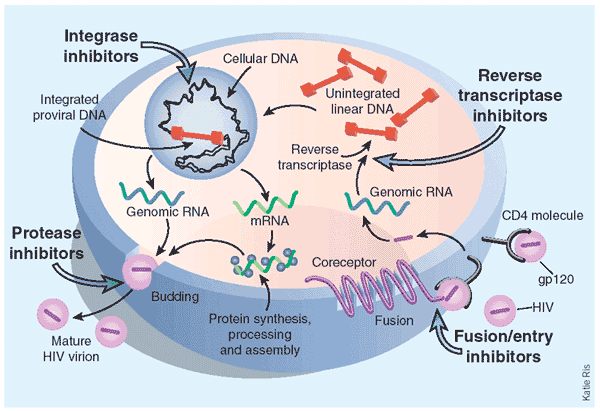
People with HIV in the United States are likely to get a further option for use in first-line drug combinations within the next few weeks, following the decision by the US FDA administration antiviral Drugs Advisory Committee to recommend marketing approval for maraviroc, the CCR5 inhibitor. CCR5 inhibitors work at the entry receptor level of the virus, T-cell interface.
Alpha sun with the preliminary finding that it may block entry of the virus into the T-cell may act in the same way.
______________
Four million now receiving Antiretroviral therapy, 6 million still in need. United Nations Agencies.
Although 4 million people are now receiving antiretroviral therapy in low and middle income countries, another 5 million adults and children lack access to treatment in low and middle income countries.
Abacavir a NRTI has been shown to impair endothelial function, providing a possible explanation for the drugs association with an increased risk of heart attack.
Abacavir toxicity has been the subject of intense debate whether it does or does not increase the risk of cardiovascular disease.
What is interesting is that we are studying Blue Green Algae, or Alpha Sun, a bone marrow stem cell stimulator which decreases inflammation in many settings. Endothelial function impairment is caused by inflammation. It seems logical that Blue green algae, as proposed as a possible solution to toxicity for HIV medication, could be used in Abacavir patients not only to stop the virus, but to decrease the side effects namely cardiovascular disease caused by inflammation of the endothelium of the arteries.
____________________
Breast Tenderness After Starting Combination Hormone Therapy May Indicate Higher Breast Cancer Risk. Archives of Internal Medicine October 14,2009
Postmenopausal women who experience new-onset breast tenderness after starting combination hormone therapy may face increased risk for breast cancer,. Researchers examined data on l7,000 Women's Health Initiative participants who were randomized to receive estrogen-progestin or placebo daily. In the hormone group, women with new onset breast tenderness t 12 months were about 50% more likely to be diagnosed with breast cancer during 5.5 years follow-up, relative to those without tenderness. There was no such association among placebo recipients.
The sensitivity and specificity of breast tenderness for predicting cancer risk were 41% and 64% respectively--which, the authors say, are similar to values for the Gail model.
The authors note that hormone-induced elevations in serum estrone and estrone sulfate might lead to increased breast tenderness and heightened rsk. They futher state that these findings should be considered by prescribing physicians to inform decisons regarding continued combined hormone therapy.
____________________
Topical treatment for pre-cancerous anal cell changes safe and moderately effective Journal of Acquired Immune Deficiency Syndrome
A course of treatment with topical trichloracetic acid appears to provide a safe and effective treatment for pre-cancerous cell change in the anus, US investigators report in a study published in the online edition of the Journal of acquired Immune deficiency syndromes. The treatment was equally effective in HIV-Positive and HIV-negative men.
___________________
Food insecurity increases risk of death for patients taking HIV-treatment in Canada J.Acq. Def. Synd. October 2009
Patients taking HIV treatment in Vancouver, Canada, who are food insecure have an increased risk of death, researchers report in the online edition of the Journal of acquired Immune deficiency Syndromes. The risk of death was especially hligh for food=insecure individuals who were of low weight.
_________________________
CD 4-cell-count below 400 increases cancer risk for patients with HIV October 9th Lancet Oncology
Maintaining a CD 4 cell count above 500 will protect HIV+ patients from a range of AIDS-defining and non-AIDS defining caners. this study was performed by french investigators and is presented in a paper published online on October 8th in The lancet Oncology.
____________
FDA committee recommends approval of maraviroc for first-line treatment in US
People with HIV in the United States are likely to get a further option for use in first-line drug combinations within the next few weeks, following the decision by the US FDA administration antiviral Drugs Advisory Committee to recommend marketing approval for maraviroc, the CCR5 inhibitor. CCR5 inhibitors work at the entry receptor level of the virus, T-cell interface.
Alpha sun with the preliminary finding that it may block entry of the virus into the T-cell may act in the same way.
______________
Four million now receiving Antiretroviral therapy, 6 million still in need. United Nations Agencies.
Although 4 million people are now receiving antiretroviral therapy in low and middle income countries, another 5 million adults and children lack access to treatment in low and middle income countries.
The Peter Schick Foundation has submitted its request for an IND Number from the FDA
The Peter Schick Foundation has submitted all the necessary data to obtain an IND number from the FDA for the product Alpha Sun. Alpha Sun is made by Simplexity Health of Klamath Falls, Oregon. The product, a bone marrow stem cell stimulator, increases the number of circulating stem cells 20-30% two hours after oral ingestion of l000mg/day. The foundation hopes to test the product in a number of clinical studies, namely Type 2 Diabetes and HIV+ patients who are virologically suppressed on antiretroviral therapy. Additional studies in the works include testing the product in osteoarthitis patients, osteoporosis patients, prostatitis patients, Acne patients, post-operative inguinal hernia patients, carpal tunnel patients, and Cardiac rehabilitation patients. The product has significant anti inflammatory capabilities, is a mood elevator, and has a carbohydrate that directs bone marrow stem cells to the point of inflammation and injury where it initiates repair of damage caused by an inflammatory process. Two initial trials will be done for Type 2 Diabetes, and another for HIV+ patients who are virologically suppressed on antiretroviral therapy.
The Peter Schick Foundation and Simplexity Health are forming a partnership to study in clinical trials Aphanizomenon Flos-Aquae (termed AFA), which is the major component of the product Alpha Sun.
A C corporation will be formed with available common shares of stock. If you wish to learn more about the offering or donate to the non-profit 501(c)(3) foundation, please email schickpm@aol.com or contribute by mail to the Schick Foundation, 1223 Wilshire Blvd. #1007, Santa Monica, CA 90403.
The Peter Schick Foundation and Simplexity Health are forming a partnership to study in clinical trials Aphanizomenon Flos-Aquae (termed AFA), which is the major component of the product Alpha Sun.
A C corporation will be formed with available common shares of stock. If you wish to learn more about the offering or donate to the non-profit 501(c)(3) foundation, please email schickpm@aol.com or contribute by mail to the Schick Foundation, 1223 Wilshire Blvd. #1007, Santa Monica, CA 90403.
The Perilous Success: What if the new HIV prevention methods work?
The Perilous Success: What if the new HIV prevention methods work?
AIDS Weekly
September 15, 2009
Within a couple of years, we may know if two crucial new HIV prevention approaches will work. If they do, what then? Who will pay for them, who will use them, and will their use have a positive or negative impact on the epidemic?
This was a debate carried on at the IAS conference advocacy coalition as they looked at the possibility of microbicides and pre-exposure prophylaxis(PrEP).
Microbicides are a long way from being a preventative approach to HIV infection, both because of scientific and behavioral concerns. Pre-exposure prophylaxis also has strong behavioral concerns even if it is accepted scientifically.
The only real way of prevention is to treat everyone with antiretroviral meds in a high incidence area.
AIDS Weekly
September 15, 2009
Within a couple of years, we may know if two crucial new HIV prevention approaches will work. If they do, what then? Who will pay for them, who will use them, and will their use have a positive or negative impact on the epidemic?
This was a debate carried on at the IAS conference advocacy coalition as they looked at the possibility of microbicides and pre-exposure prophylaxis(PrEP).
Microbicides are a long way from being a preventative approach to HIV infection, both because of scientific and behavioral concerns. Pre-exposure prophylaxis also has strong behavioral concerns even if it is accepted scientifically.
The only real way of prevention is to treat everyone with antiretroviral meds in a high incidence area.
India says no to HIV drug patents
India says no to HIV drug patents
Nature News
September 3, 2009
India has rejected applications for patents from two US drug pharmaceutical companies for two AIDS drugs which could mean that more poor people in poor countries will have access to life saving medicines. The decisions are the latest in a string of legal victories for Cipla, India's largest generic drug maker. The move could also signal that patent offices in emerging economies are set to take a tougher line than industrialized countries on which drugs deserve patents. The drugs rejected are Gilead's drug Tenofovir and Tibotec's drug Darunavir.

Nature News
September 3, 2009
India has rejected applications for patents from two US drug pharmaceutical companies for two AIDS drugs which could mean that more poor people in poor countries will have access to life saving medicines. The decisions are the latest in a string of legal victories for Cipla, India's largest generic drug maker. The move could also signal that patent offices in emerging economies are set to take a tougher line than industrialized countries on which drugs deserve patents. The drugs rejected are Gilead's drug Tenofovir and Tibotec's drug Darunavir.
Schick Foundation Looks To Partner With Simplexity
Schick Foundation Looks To Partner With Simplexity
The Peter Schick Foundation is forming a partnership with Simplexity Health of Klamath Falls, Oregon. Simplexity Health is the maker and distributor of Blue Green Algae, which is marketed under the brand name Alpha Sun. Its main component is the algae aphanizomenon-flos-aquae (AFA). The agreement reached in principal will allow The Schick Foundation to finally submit the necessary data to the FDA to get an IND number. This should lead to rapid approval of the IND number, and allow the foundation to start its clinical research protocols in virologically suppressed HIV+ patients being treated with 1000 mg of AFA per day in addition to their suppressive antiretroviral treatment.
These are patients naive to antiretroviral treatment with low levels of virus. The foundation will also study Type 2 Diabetes and the effects of AFA on this common disease state which causes more morbidity and hospitalization costs than any other disease in this country. The two organizations – Simplexity Health and the Peter Schick Foundation – will form a for-profit/non-profit entity which is being formed by a local law firm that specializes in working with nonprofit agencies. This will allow both organizations to benefit greatly.
To help with the costs of these two revolutionary protocols, tax-deductible donations can be made to the Peter Schick Foundation, 1223 Wilshire Blvd #1007, Santa Monica, California, 90403.
The Peter Schick Foundation is forming a partnership with Simplexity Health of Klamath Falls, Oregon. Simplexity Health is the maker and distributor of Blue Green Algae, which is marketed under the brand name Alpha Sun. Its main component is the algae aphanizomenon-flos-aquae (AFA). The agreement reached in principal will allow The Schick Foundation to finally submit the necessary data to the FDA to get an IND number. This should lead to rapid approval of the IND number, and allow the foundation to start its clinical research protocols in virologically suppressed HIV+ patients being treated with 1000 mg of AFA per day in addition to their suppressive antiretroviral treatment.
These are patients naive to antiretroviral treatment with low levels of virus. The foundation will also study Type 2 Diabetes and the effects of AFA on this common disease state which causes more morbidity and hospitalization costs than any other disease in this country. The two organizations – Simplexity Health and the Peter Schick Foundation – will form a for-profit/non-profit entity which is being formed by a local law firm that specializes in working with nonprofit agencies. This will allow both organizations to benefit greatly.
To help with the costs of these two revolutionary protocols, tax-deductible donations can be made to the Peter Schick Foundation, 1223 Wilshire Blvd #1007, Santa Monica, California, 90403.
Mediterranean Diet Improves Glycemic Control in Patients with Type 2 Diabetes
Mediterranean Diet Improves Glycemic Control in Patients with Type 2 Diabetes
Annals of Internal Medicine
August 2009
A Mediterranean-style diet may be better than a low-fat diet for helping patients with type 2 diabetes, and delay treatment with anihyperglycemic drugs.
Italian researchers randomized some 200 overweight patients with newly diagnosed diabetes to either a Mediterranean-style diet (less than 50% of calories from carbohydrates) or a low-fat diet (less than 30% of calories from fat).
At four years, fewer patients on the Mediterranean diet than on the low-fat diet had HbA1C levels greater than 7%, thus requiring treatment with anihyperglycemic drugs (44% vs 70%). The Mediterranean diet group also had a larger increase in insulin sensitivity, greater weight loss, and reduced coronary risk factors.
The authors say the Mediterranean diet's effects could be explained by the high consumption of monounsaturated fatty acids, which may increase insulin sensitivity. They conclude:
"The findings reinforce the message that benefits of lifestyle interventions should not be overlooked.”
Diet and exercise are the hallmarks of treating type 2 diabetes. This includes patients with HIV.
Schick Research is conducting a study that may prove that blue-green algae, because it changes the milieu of the GI tract and the pancreas, may be used to control type 2 diabetes. If our study is proven successful, it may replace oral insulin in these patients.
Annals of Internal Medicine
August 2009
A Mediterranean-style diet may be better than a low-fat diet for helping patients with type 2 diabetes, and delay treatment with anihyperglycemic drugs.
Italian researchers randomized some 200 overweight patients with newly diagnosed diabetes to either a Mediterranean-style diet (less than 50% of calories from carbohydrates) or a low-fat diet (less than 30% of calories from fat).
At four years, fewer patients on the Mediterranean diet than on the low-fat diet had HbA1C levels greater than 7%, thus requiring treatment with anihyperglycemic drugs (44% vs 70%). The Mediterranean diet group also had a larger increase in insulin sensitivity, greater weight loss, and reduced coronary risk factors.
The authors say the Mediterranean diet's effects could be explained by the high consumption of monounsaturated fatty acids, which may increase insulin sensitivity. They conclude:
"The findings reinforce the message that benefits of lifestyle interventions should not be overlooked.”
Diet and exercise are the hallmarks of treating type 2 diabetes. This includes patients with HIV.
Schick Research is conducting a study that may prove that blue-green algae, because it changes the milieu of the GI tract and the pancreas, may be used to control type 2 diabetes. If our study is proven successful, it may replace oral insulin in these patients.
Miracle Superfood: Wild Blue-Green Algae
Miracle Superfood: Wild Blue-Green Algae
Gillian McKeith, Ph.D.
Keats Good Health Guide
The nutrient powerhouse that stimulates the immune system, boosts brain power and guards against disease.
Many of you have asked what the components are of Blue Green Algae. The body is capable of utilizing virtually all of the algae's nutrients. When making a conventional multiple vitamin with mineral, the body is capable of utilizing virtually all of the algae nutrients. When taking a conventional multiple vitamin with minerals, the body may only absorb a small fraction of the actual nutrient dosages.
The component of AFA algae is as follows:
Minerals. One of the greatest contributions of Blue-Green AFA algae is a full spectrum of minerals. Minerals are the framework for our bodies, critical to our overall mental and physical well-being. Bones, teeth, muscle, blood, nerve cells, tissues and internal fluids all contain varying quantities of minerals. They help to build the skeletal structure, regulate the heart, balance internal pressure of body flies, nerve response and oxygen transport from the lungs to the tissues. Minerals act as a catalyst for many biological reactions within the body including muscle response, digestion, metabolism of nutrients in foods, and transmission of messages through the nervous systems. Minerals help to maintain the body's delicate water balance, allowing the mental and physical processes to function properly. They keep blood and tissue fluids from becoming too acid or too alkaline, the balancing the body's PH. Minerals permit other nutrients to pass into the bloodstream.
The problem with minerals, however, is that they can only be supplied through the food one eats. The different minerals in AFA are Boron, Calcium, Chloride, Chromium, Cobalt, Copper, Fluoride, Germanium, Iodine, Iron, Magnesium Manganese, Molybdenum, Nickel, Phosphorous, Potassium, Selenium, Silicon, Sodium, Tin, Titanium Vanadium and Zinc. These are not present in any toxic amounts.
Proteins and amino acids. Wild blue-green algae is an exceptionally high source of proteins (60%) nearly identical to the human body's protein composition. The quality of the protein in AFA algae is superior to that of most other plant or animal protein sources, being derived from all eight essential amino acids. It is important for general good health of the skin, hair, nails, brain, ligaments, bones, teeth, hormones, sex glands, and enzymes that we eat foods with. If one of the eight essential amino acids is missing, then the body cannot make protein.
The essential amino acids that AFA has is isoleucine, leucine, lysine, methionine, tryptophan, threonine, phenyalanine, and valine. The semi-essential amino acids that AFA has are arginine and histidine. The non-essential amino acids that AFA has is Alanine, aspartic acid, cystine, glutamic acid, proline, serine, and tyrosine.
AFA is rich in all kinds of botanical pigments. A pigment is a molecular capsule of absorbing wavelength of light which is then reflected as a recognizable color. AFA has Chlorophyll – a permanent pigment. Chlorophyll is the livelihood of AFA algae. It is similar in molecular structure to heme, the oxygen carrying and pigment of human blood. Phycocyanines are present in AFA. Phycocyanin is the pigment which gives wild blue-green algae its blue base. It is a protein which has been shown to inhibit the formation of "cancer colonies". These pigments operate with billirubin to keep the liver functioning. Phycocyanin helps draw gogether amino acids for neurotransmitter function, which may increase mental capacity.
Wild blue-green algae contains approximately four percent RNA/DNA. The RNA/DNA (nucleic acid) is needed for growth of body tissues and to make new cells, repair damaged cells, and for growth of body tissue. As people get older, the levels of RNA/DNA decrease. If you do not have enough RNA/DNA, you may suffer the consequences of a weak immune system and ultimately age prematurely. Inferior eating habits, pollution, and stress can deplete your RNA/DANA quotient. Keeping the RNA/DNA levels at a consistent level is important if you want to retard your cells destruction, enhance immunity, and regenerate your body.
Lipids, through essential fatty acids, are highly represented in blue-green algae. These lipids are critical for life itself and provide the most concentrated source of energy for the body. Fatty acids function as carriers for vitamins A, E, and K. Lipids within AFA can prevent the skin and other bodily tisssues from becoming dry and scaly. The omega-3 fatty acids are known to help prevent heart diseasse, reduce serum cholesterol and raise HDL (good cholesterol) in addition to improving brain function.
Wild blue-green algae is one of the highest known natural sources of beta-carotene. Beta-carotene is a powerful antioxidant and anti-infective protective agent against skin disorders, night blindness, allergies, and immune system dysfunction.
Finally, AFA – with its particle L-selectin Ligan – releases adult bone marrow stem cells from the bone marrow of people who take it. Stem cells are the center of the universe for the immune system and can control with help all immune cellular in antibody function.
Gillian McKeith, Ph.D.
Keats Good Health Guide
The nutrient powerhouse that stimulates the immune system, boosts brain power and guards against disease.
Many of you have asked what the components are of Blue Green Algae. The body is capable of utilizing virtually all of the algae's nutrients. When making a conventional multiple vitamin with mineral, the body is capable of utilizing virtually all of the algae nutrients. When taking a conventional multiple vitamin with minerals, the body may only absorb a small fraction of the actual nutrient dosages.
The component of AFA algae is as follows:
Minerals. One of the greatest contributions of Blue-Green AFA algae is a full spectrum of minerals. Minerals are the framework for our bodies, critical to our overall mental and physical well-being. Bones, teeth, muscle, blood, nerve cells, tissues and internal fluids all contain varying quantities of minerals. They help to build the skeletal structure, regulate the heart, balance internal pressure of body flies, nerve response and oxygen transport from the lungs to the tissues. Minerals act as a catalyst for many biological reactions within the body including muscle response, digestion, metabolism of nutrients in foods, and transmission of messages through the nervous systems. Minerals help to maintain the body's delicate water balance, allowing the mental and physical processes to function properly. They keep blood and tissue fluids from becoming too acid or too alkaline, the balancing the body's PH. Minerals permit other nutrients to pass into the bloodstream.
The problem with minerals, however, is that they can only be supplied through the food one eats. The different minerals in AFA are Boron, Calcium, Chloride, Chromium, Cobalt, Copper, Fluoride, Germanium, Iodine, Iron, Magnesium Manganese, Molybdenum, Nickel, Phosphorous, Potassium, Selenium, Silicon, Sodium, Tin, Titanium Vanadium and Zinc. These are not present in any toxic amounts.
Proteins and amino acids. Wild blue-green algae is an exceptionally high source of proteins (60%) nearly identical to the human body's protein composition. The quality of the protein in AFA algae is superior to that of most other plant or animal protein sources, being derived from all eight essential amino acids. It is important for general good health of the skin, hair, nails, brain, ligaments, bones, teeth, hormones, sex glands, and enzymes that we eat foods with. If one of the eight essential amino acids is missing, then the body cannot make protein.
The essential amino acids that AFA has is isoleucine, leucine, lysine, methionine, tryptophan, threonine, phenyalanine, and valine. The semi-essential amino acids that AFA has are arginine and histidine. The non-essential amino acids that AFA has is Alanine, aspartic acid, cystine, glutamic acid, proline, serine, and tyrosine.
AFA is rich in all kinds of botanical pigments. A pigment is a molecular capsule of absorbing wavelength of light which is then reflected as a recognizable color. AFA has Chlorophyll – a permanent pigment. Chlorophyll is the livelihood of AFA algae. It is similar in molecular structure to heme, the oxygen carrying and pigment of human blood. Phycocyanines are present in AFA. Phycocyanin is the pigment which gives wild blue-green algae its blue base. It is a protein which has been shown to inhibit the formation of "cancer colonies". These pigments operate with billirubin to keep the liver functioning. Phycocyanin helps draw gogether amino acids for neurotransmitter function, which may increase mental capacity.
Wild blue-green algae contains approximately four percent RNA/DNA. The RNA/DNA (nucleic acid) is needed for growth of body tissues and to make new cells, repair damaged cells, and for growth of body tissue. As people get older, the levels of RNA/DNA decrease. If you do not have enough RNA/DNA, you may suffer the consequences of a weak immune system and ultimately age prematurely. Inferior eating habits, pollution, and stress can deplete your RNA/DANA quotient. Keeping the RNA/DNA levels at a consistent level is important if you want to retard your cells destruction, enhance immunity, and regenerate your body.
Lipids, through essential fatty acids, are highly represented in blue-green algae. These lipids are critical for life itself and provide the most concentrated source of energy for the body. Fatty acids function as carriers for vitamins A, E, and K. Lipids within AFA can prevent the skin and other bodily tisssues from becoming dry and scaly. The omega-3 fatty acids are known to help prevent heart diseasse, reduce serum cholesterol and raise HDL (good cholesterol) in addition to improving brain function.
Wild blue-green algae is one of the highest known natural sources of beta-carotene. Beta-carotene is a powerful antioxidant and anti-infective protective agent against skin disorders, night blindness, allergies, and immune system dysfunction.
Finally, AFA – with its particle L-selectin Ligan – releases adult bone marrow stem cells from the bone marrow of people who take it. Stem cells are the center of the universe for the immune system and can control with help all immune cellular in antibody function.
AIDS Study on antiretroviral therapy initiation
AIDS Study on antiretroviral therapy initiation
The objective of this study was to examine HIV specific CD8+ T cells from patients with primary HIV infection and other antiretroviral therapy initiation, which were evaluated for CD 127 expression and proliferating capacity and were compared with cells from chronically-infected patients including long-term nonprogressors and HIV elite controllers.
Thirty patients were studied with primary HIV infection and 33 patients were studied with chronic HIV infection including nonprogressors and elite controllers. HIV-specific CD8+ cells were identified by costaining with HIV human leukocyte antigen Class 1 pentamers. CD127 expression was assed by flow cytometry and cell proliferation for carboxyfluorescein succinimidyl ester labeling.
The results showed that during Primary HIV infection most HIV specific CD8+ T cells coexpressed CD27 and CD45RO and were highly activated. Their CD127 expression was very low and correlated negatively with both HIV RNA and DNA levels and with expression of the activation marker CD38. CD127 expression correlated positively with CD4 cell count. Some CD127 expression was observed in the two groups of chronically-infected nonprogressors. CD127 expression on HIV specific CD8+ T cells increased in early-treated primary HIV patients, matching levels similar to those observed in nonprogoressors. In parallel, these cells acquired strong proliferating capacity. No change in CD127 expression or proliferative potential was observed in untreated patients.
The conclusion of this study was that early antiretroviral therapy initiation enhances CD127 expression on HIV-specific CD8+ T cells, reaching levels similar to those observed in aviremic nonprogressors and restores their proliferative capacity allowing them to fight HIV.
This is an interesting study. The only problem is that early HIV infection is hardly ever found. Most patients have well-established infections when they are discovered to be HIV positive and some of them are discovered late in the course of HIV infection.
The objective of this study was to examine HIV specific CD8+ T cells from patients with primary HIV infection and other antiretroviral therapy initiation, which were evaluated for CD 127 expression and proliferating capacity and were compared with cells from chronically-infected patients including long-term nonprogressors and HIV elite controllers.
Thirty patients were studied with primary HIV infection and 33 patients were studied with chronic HIV infection including nonprogressors and elite controllers. HIV-specific CD8+ cells were identified by costaining with HIV human leukocyte antigen Class 1 pentamers. CD127 expression was assed by flow cytometry and cell proliferation for carboxyfluorescein succinimidyl ester labeling.
The results showed that during Primary HIV infection most HIV specific CD8+ T cells coexpressed CD27 and CD45RO and were highly activated. Their CD127 expression was very low and correlated negatively with both HIV RNA and DNA levels and with expression of the activation marker CD38. CD127 expression correlated positively with CD4 cell count. Some CD127 expression was observed in the two groups of chronically-infected nonprogressors. CD127 expression on HIV specific CD8+ T cells increased in early-treated primary HIV patients, matching levels similar to those observed in nonprogoressors. In parallel, these cells acquired strong proliferating capacity. No change in CD127 expression or proliferative potential was observed in untreated patients.
The conclusion of this study was that early antiretroviral therapy initiation enhances CD127 expression on HIV-specific CD8+ T cells, reaching levels similar to those observed in aviremic nonprogressors and restores their proliferative capacity allowing them to fight HIV.
This is an interesting study. The only problem is that early HIV infection is hardly ever found. Most patients have well-established infections when they are discovered to be HIV positive and some of them are discovered late in the course of HIV infection.
The Top 18 FAT Fighting Foods
The Top 18 FAT Fighting Foods
Patrick Tsakude, LA Health
August 2009
Increase your body's fat-burning power by eating these top-fat-fighting foods. #1 Oatmeal, #2 Leafy Greens, #3 Olive oil, #4 Garlic, #5 Tomatoes, #6 Nuts, #7 Cayenne, #8 Turmeric, #9 Cinnamon, #l0 Flax seeds, #11 Apple, #12 Beans, #13 Green Tea, #14 Grapefruit, #15 Broccoli, #16 Lean Turkey, #17 Hot Sauce, #18 Soup.
Patrick Tsakude, LA Health
August 2009
Increase your body's fat-burning power by eating these top-fat-fighting foods. #1 Oatmeal, #2 Leafy Greens, #3 Olive oil, #4 Garlic, #5 Tomatoes, #6 Nuts, #7 Cayenne, #8 Turmeric, #9 Cinnamon, #l0 Flax seeds, #11 Apple, #12 Beans, #13 Green Tea, #14 Grapefruit, #15 Broccoli, #16 Lean Turkey, #17 Hot Sauce, #18 Soup.
Steroids Might Relieve Sore Throat Pain
Steroids Might Relieve Sore Throat Pain
Journal Watch
August 28, 2009
A meta-analysis shows that a single dose of steroids, given in addition to standard antibiotics, hastens resolution of pain in adults with exudative pharyngitis or bacterial pharyngitis. There are many over-the-counter drugs that do the same thing (relieve sore throat pain).
Having doctors prescribe steroids as a one time dose will just increase medical costs, might lead to prolonged use of steroids in some patients, and certainly sore throats can be treated successfully and without pain, without steroids.
Journal Watch
August 28, 2009
A meta-analysis shows that a single dose of steroids, given in addition to standard antibiotics, hastens resolution of pain in adults with exudative pharyngitis or bacterial pharyngitis. There are many over-the-counter drugs that do the same thing (relieve sore throat pain).
Having doctors prescribe steroids as a one time dose will just increase medical costs, might lead to prolonged use of steroids in some patients, and certainly sore throats can be treated successfully and without pain, without steroids.
FDA Warning
FDA Warning
Etravirine, an antiretroviral, has been linked to several skin and hypersensitivity reactions.
Etravirine, (Intelence), a valuable antiretroviral drug has been associated with severe skin reactions including Stevens-Johnson syndrome, toxic epidermal necrolysis, erythema multiforme, and hypersensitivity reactions characterized by rash. Patients experiencing any of these signs or symptoms should discontinue use of the drug immediately according to the agency.
The FDA does not state how many people experience this complication. The box label had these same reations as very rare. This is exactly the type of meddling that the FDA is doing these days. Many companies are scared off this type of regulatory behavior. It is time for a change in the FDA.
Etravirine, an antiretroviral, has been linked to several skin and hypersensitivity reactions.
Etravirine, (Intelence), a valuable antiretroviral drug has been associated with severe skin reactions including Stevens-Johnson syndrome, toxic epidermal necrolysis, erythema multiforme, and hypersensitivity reactions characterized by rash. Patients experiencing any of these signs or symptoms should discontinue use of the drug immediately according to the agency.
The FDA does not state how many people experience this complication. The box label had these same reations as very rare. This is exactly the type of meddling that the FDA is doing these days. Many companies are scared off this type of regulatory behavior. It is time for a change in the FDA.
Go Easy on the Salt Eduardo Pementa from Brisbane, Australia

People with high blood pressure that are not controlled by multiple medications are likely eating too much salt, new findings in the journal Hypertension show. Individuals with so-called resistant hypertension showed sharp reductions in their blood pressure when they dramatically cut their salt intake, Dr.Eduardo Pimenta of Brisbane Australia and his colleagues found.
The Top 18 FAT Fighting Foods Patrick Tsakude LA Health August 2009

Increase your body's fat-burning power by eating these top-fat-fighting foods. #1 Oatmeal, #2, Leafy Greens, #3 Olive oil, #4, Garlic, #5, Tomatoes, #6, Nuts #7, Cayenne, #8, Turmeric, #9,Cinnamon, #10, Flax seeds, #11, Apple, #12, Beans, #13, Green Tea, #14, Grapefruit, #15, Broccoli, #16, Lean Turkey, #17, Hot Sauce, #18, Soup.
Effective Local Therapy and long-term Survival in Breast Cancer Winkfield, Karen MD, PHD, Harvard Medical School
The causal link between local control and long-term survival in breast cancer has become clearer over the past few years. Although the prevalence of breast cancer is high, there has been a steady decline in breast cancer mortality since the early l990's. Improvements in breast cancer-specific mortality are the result of greater emphasis on cancer screening and improved treatment modalities, principally the development of effective adjuvant systemic therapy. Adjuvant radiation therapy (RT) substantially reduces local recurrence rates, and this reduction is even greater when combined with systemic therapy.
Randomized controlled trials and meta-analysis have shown that reducing local recurrence improves overall long-term survival both mastectomy and breast-conserving therapy. Clinical and translational research has began to shed light on new prognostic and predictive markers than can assist in the assessment of an individual patient's risk of local recurrence without RT and the likelihood of a survival benefit with RT. The ability to appropriate tailor therapy to recue local recurrence rates is vital toward continuing the decline in breast cancer mortality.
The increased survival of HIV+ women with antiretroviral therapy has made it necessary for them to be informed about breast cancer, sreening and self examination are the most important preventative measures and being informed about the special doctors who specialize in breast cancer treatment is the next most important fact to know.
Randomized controlled trials and meta-analysis have shown that reducing local recurrence improves overall long-term survival both mastectomy and breast-conserving therapy. Clinical and translational research has began to shed light on new prognostic and predictive markers than can assist in the assessment of an individual patient's risk of local recurrence without RT and the likelihood of a survival benefit with RT. The ability to appropriate tailor therapy to recue local recurrence rates is vital toward continuing the decline in breast cancer mortality.
The increased survival of HIV+ women with antiretroviral therapy has made it necessary for them to be informed about breast cancer, sreening and self examination are the most important preventative measures and being informed about the special doctors who specialize in breast cancer treatment is the next most important fact to know.
AIDS vaccine funding down l0% in 2008.
IAS conference Capetown South Africa July l9-22 2009
Funding for AIDS vaccine research fell by l0% in 2008, the first decline in a decade, according to figures released by the HIV Vaccine and Microbicide Resource Tracking Working Group.
This data was not unexpected. With the failure of the Gov-Merc vaccine trial in Africa known as the Step trial and the CDC calling for a halt in HIV/AIDS Vaccines trials until some more basic research on the virus was completed a vaccine for HIV seems now remote in the near future.
Funding for AIDS vaccine research fell by l0% in 2008, the first decline in a decade, according to figures released by the HIV Vaccine and Microbicide Resource Tracking Working Group.
This data was not unexpected. With the failure of the Gov-Merc vaccine trial in Africa known as the Step trial and the CDC calling for a halt in HIV/AIDS Vaccines trials until some more basic research on the virus was completed a vaccine for HIV seems now remote in the near future.
Antiretroviral roll-out results in major TB decline in South African study.
Presented at the IAS conference.
The roll-out of antiretroviral treatment to cover 90% of eligible people has resulted in a significant decline in new cases of TB in a South African township, demonstrating for the first time the potential of antiretroviral treatment to make major inroads into the burden of TB in high prevalence countries.
This is a very important study and good news. TB is responsible for more deaths in the world than any infectious disease including HIV.
The roll-out of antiretroviral treatment to cover 90% of eligible people has resulted in a significant decline in new cases of TB in a South African township, demonstrating for the first time the potential of antiretroviral treatment to make major inroads into the burden of TB in high prevalence countries.
This is a very important study and good news. TB is responsible for more deaths in the world than any infectious disease including HIV.
Boosted darunavir mono therapy works well in two studies
Presented at the IAS conference in Cape town.
Ritonavir-boosted darunavir alone maintains HIV suppression in most patients who achieved an undetectable viral load on combination antiretroviral therapy, according to two studies presented at this conference.
This is important because now patients have another option after combination antiretroviral therapy has gotten to an undetectable viral load level. Maintenance therapy with daurnavir is an acceptable choice as is atazanavir.
Combination therapy to suppress the virus followed by maintenance therapy is becoming a more and more attractive way of treating HIV+ patients, especially those patients that present with low CD 4 levels.
Ritonavir-boosted darunavir alone maintains HIV suppression in most patients who achieved an undetectable viral load on combination antiretroviral therapy, according to two studies presented at this conference.
This is important because now patients have another option after combination antiretroviral therapy has gotten to an undetectable viral load level. Maintenance therapy with daurnavir is an acceptable choice as is atazanavir.
Combination therapy to suppress the virus followed by maintenance therapy is becoming a more and more attractive way of treating HIV+ patients, especially those patients that present with low CD 4 levels.
Antiretrovirals and condoms will have more effect on HIV in south Africa than circumcision, model finds.
From the IAS Conference in Cape town South Africa July 19-22, 2009.
In preliminary results from a mathematical model set up by researchers from the British Columbia Center for Excellence in HIV/AIDS, male circumcision was found to have a considerable lower impact than condom use or antiretroviral therapy coverage on new HIV infection rates and on death rates in men in South Africa.
This finding support the concept that in countries with high prevalence of HIV+ people that treating people not infected with HIV with antiretroviral therapy is the best way of preventing HIV, not microbicides not vaginal barriers, not condoms, not circumcision, and not the behaviorally unusable concept of abstinence.
In preliminary results from a mathematical model set up by researchers from the British Columbia Center for Excellence in HIV/AIDS, male circumcision was found to have a considerable lower impact than condom use or antiretroviral therapy coverage on new HIV infection rates and on death rates in men in South Africa.
This finding support the concept that in countries with high prevalence of HIV+ people that treating people not infected with HIV with antiretroviral therapy is the best way of preventing HIV, not microbicides not vaginal barriers, not condoms, not circumcision, and not the behaviorally unusable concept of abstinence.
Menopause does not affect response to HIV treatment
Menopause does not affect response to HIV treatment
August 1st edition of Clinical Infectious diseases.
Menopausal status does not effect responses to HIV treatment, US investigators report in the the largest ever study into the impact of menopause on the effectiveness of HIV treatment. The researchers found that CD 4 cell counts and viral loads were comparable in pre-and post menopausal woman two years after initiating potent HIV therapy.
August 1st edition of Clinical Infectious diseases.
Menopausal status does not effect responses to HIV treatment, US investigators report in the the largest ever study into the impact of menopause on the effectiveness of HIV treatment. The researchers found that CD 4 cell counts and viral loads were comparable in pre-and post menopausal woman two years after initiating potent HIV therapy.
HIV treatment and traditional risk factors causing hardening of the arteries
HIV treatment and traditional risk factors causing hardening of the arteries American Journal of Hypertension, online edition.
Treatment with antiretroviral drugs can cause hardening of the arteries, Greek investigators report. Traditional risk factors for hardening of the arteries, also known as arteriosclerosis, such as cholesterol and high blood pressure were also shown to be important. The Schick Foundation is embarking on a study using blue green algae supplement in HIV+ patients virologically suppressed on antiretroviral drugs. We have put forth theories why an anti inflammatory agent such as blue green algae which releases bone marrow stem cells into the circulation of up to 30 % higher than normal.
These theories include the algae can get into the reservoirs, the blue green algae can extend the life span of infected memory t cells, the blue green algae can block absorption of the virus from entering the GI tract and starting immune activation by microbial translocation, and finally with residual HIV present in suppressed patients the stem cell which is the center of the immune system might be able to regulate the eradication of the last virus present by an active immune system. There may be another benefit of the blue green algae and that is by its anti inflammatory manner it may stop many of the side effects of antiretroviral treatment such as vascular disease, and hypertension.
Treatment with antiretroviral drugs can cause hardening of the arteries, Greek investigators report. Traditional risk factors for hardening of the arteries, also known as arteriosclerosis, such as cholesterol and high blood pressure were also shown to be important. The Schick Foundation is embarking on a study using blue green algae supplement in HIV+ patients virologically suppressed on antiretroviral drugs. We have put forth theories why an anti inflammatory agent such as blue green algae which releases bone marrow stem cells into the circulation of up to 30 % higher than normal.
These theories include the algae can get into the reservoirs, the blue green algae can extend the life span of infected memory t cells, the blue green algae can block absorption of the virus from entering the GI tract and starting immune activation by microbial translocation, and finally with residual HIV present in suppressed patients the stem cell which is the center of the immune system might be able to regulate the eradication of the last virus present by an active immune system. There may be another benefit of the blue green algae and that is by its anti inflammatory manner it may stop many of the side effects of antiretroviral treatment such as vascular disease, and hypertension.
Removal of US entry ban for people with HIV moves a step closer
Removal of US entry ban for people with HIV moves a step closer NAM July 7,2009
Hopes that restrictions on entry to the US for pepe with HIV will final be removed were raised when the US government indicated that it had completed a review of the removal of HIV from the list of communicable diseases that prevent entry to the US. This is very good news for many reasons. Maybe the IAS can start having conferences in the USA instead of Cape town South Africa, and Vienna Austria.
Hopes that restrictions on entry to the US for pepe with HIV will final be removed were raised when the US government indicated that it had completed a review of the removal of HIV from the list of communicable diseases that prevent entry to the US. This is very good news for many reasons. Maybe the IAS can start having conferences in the USA instead of Cape town South Africa, and Vienna Austria.
High HIV incidence during pregnancy: compelling reason for repeat HIV testing Moodley et al AIDS
High HIV incidence during pregnancy: compelling reason for repeat HIV testing Moodley et al AIDS 2009 23:1255-1259
The objective of this study was to determine the incidence of HIV during pregnancy as defined by seroconversion using a repeat HIV rapid testing strategy during late pregnancy. These authors tested pregnant women again after first seen by OB--GYN physicians between 36 and 40 weeks of gestation. 2377 HIV-negative woman were tested at urban and rural health institutes. 72 women were positive were comprised 13% of the population which were negative at the start at tested positive during pregnancy. The conclusion of the study is that HIV incidence during pregnancy is four times higher than in the non-pregnant population reported in a recent survey. Repeat testing is indicated to prevent mother to child transmission and further horizontal transmission.

The objective of this study was to determine the incidence of HIV during pregnancy as defined by seroconversion using a repeat HIV rapid testing strategy during late pregnancy. These authors tested pregnant women again after first seen by OB--GYN physicians between 36 and 40 weeks of gestation. 2377 HIV-negative woman were tested at urban and rural health institutes. 72 women were positive were comprised 13% of the population which were negative at the start at tested positive during pregnancy. The conclusion of the study is that HIV incidence during pregnancy is four times higher than in the non-pregnant population reported in a recent survey. Repeat testing is indicated to prevent mother to child transmission and further horizontal transmission.
Stem Cells in Cosmetic Surgery Nathan Newman, MD Published in LA Health June 2009 Issue Bone marrow stem cells are attracting much attention in the scientific community. Ongoing studies are underway in Coronary Artery Disease, Type 2 Diabetes, and other major illnesses. The area that some of the biggest advances so far is in Plastic and Reconstructive Surgery. In reconstructive surgery autologous stem cells after liposuction from a persons body have been used after processing to reconstruct major Head and neck defects after trauma, and surgery for cancer. This article show another area where bone marrow stem cells are being used and that is in Cosmetic surgery.
The method is similar to that used in Head and Neck Reconstructive surgery. Body fat is the source of the rapidly dividing cells that can be processed in the laboratory into stem cells. The procedure for cosmetic surgery is to make a small incision over an area of fat most often in the abdomen, aspirate out some fat cells, take the fat cells to the laboratory, and process them into bone marrow stem cells.
These stem cells can be used to enhance and treat the eyes, forehead, temples, cheeks, laugh lines, down lines, jowls, jaw lines, chin, hand, buttocks, calves, celuliite, dimples and scar reduction. The stem cells are injected into these areas where they reshape the natural contour of these areas. This is an exciting area for many people because it is cheaper, less invasive, and not beset with such problems as a face lift.
HIV in South Africa 'levels off'

South Africa's HIV epidemic has levelled off at an infection rate of 10.9% for those aged two or older, according to a new study.
The survey also suggests the rate of infection in children and teenagers could be falling.
This could be partly attributed to increased use of condoms, it says. But the survey warned that the overall situation remained "dire". South Africa has the world's largest HIV-positive population, at 5.5 million. Women aged between 20 and 34 continued to be the worst affected, with 33% carrying HIV, the report by the Human Sciences Research Council said.
This could be partly attributed to increased use of condoms, it says. But the survey warned that the overall situation remained "dire". South Africa has the world's largest HIV-positive population, at 5.5 million. Women aged between 20 and 34 continued to be the worst affected, with 33% carrying HIV, the report by the Human Sciences Research Council said.
Olive Shisana, an author of the study of 20,826 people released on Tuesday, said there were "promising findings of a changing pattern of HIV infection among children and youth".
"The good news is that the change in HIV prevalence in children is most likely attributable to the successful implementation of several HIV-prevention interventions," she said.
Pressure grows for lifting of HIV travel ban to USA
In July 2008 it was announced that the travel ban on HIV positive people entering America would be lifted but a year later this has yet to be implemented.
Recently a British man, Paul Thorn, who is HIV positive was scheduled to speak at a conference in Seattle but, after filling out the visa form on entry into the country, was denied access. The news comes at the same time as the International AIDS Society reiterated its desire to hold its biannual conference in Washington D.C in 2012.
Despite the announcement that the ban would be lifted there has been no mention from the current administration of when this is going to happen and in the mean time HIV positive people continue to be denied entry unless they have previously obtained a special visa.
Recently a British man, Paul Thorn, who is HIV positive was scheduled to speak at a conference in Seattle but, after filling out the visa form on entry into the country, was denied access. The news comes at the same time as the International AIDS Society reiterated its desire to hold its biannual conference in Washington D.C in 2012.
Despite the announcement that the ban would be lifted there has been no mention from the current administration of when this is going to happen and in the mean time HIV positive people continue to be denied entry unless they have previously obtained a special visa.
Breaking news from aidsmap.com
Breaking news from aidsmap.com
1) Judges, lawyers, politicians and advocates unite around the world to condemn criminalization (reported by EJ Bernard) Last year, following an epidemic of new criminal HIV transmission laws in Africa, and an increasing number of prosecutions under existing laws, South African Constitutional Court Justice Edwin Cameron made an impassioned call for “a campaign against criminalisation” in Mexico City. In the past week, Mr Justice Cameron has appeared at meetings in Sweden and Canada to help continue the campaign. Efforts to mitigate the impact of criminal prosecutions are also taking place in Australia. Last Thursday, Australian High Court Justice Virginia Bell helped launch a new criminal HIV transmission guide for legal practitioners produced by New South Wales' HIV/AIDS Legal Centre (HALC). And last Tuesday, Mr Justice Cameron addressed a meeting in Stockholm organised by HIV Sweden to discuss HIV and the criminal law in Sweden and other Nordic countries.
The Schick Foundation lauds these international efforts condemning the world’s criminal justice system’s current approach to HIV non-disclosure, exposure and transmission. Instead, we vigorously support public health measures that will get patients the treatment that they need without driving them further underground.
2) International AIDS Conference in 2012 will be held in the US if travel ban finally removed
(reported by M. Carter)
Following our previous report on activities aimed toward decriminalizing HIV around the world comes this story from our own.
An international HIV conference will be held in the US in 2012 – but only if the US removes its travel ban on HIV-positive travellers. The International AIDS Society has announced that it will hold the International AIDS Conference in the US capital, Washington, D.C., if the travel ban is finally removed. No international HIV conference has been held in the US since 1990 because of the ban. Since the Reagan presidency HIV-positive non-US citizens have been prohibited from entering the US.
The Schick Foundation condemns this ridiculous ban against allowing HIV patients from entering our country; it is quite frankly embarrassing and hidebound to say the least. We sincerely hope that President Obama will do the right thing and lift this human embargo at last.
3) Inflammation test can predict heart attacks in people with HIV (reported by G. Cairns)
Exciting news from The Journal of Acquired Immunodeficiency Syndromes: a standard test used as a marker for inflammation for 70 years can help identify heart attack risk in patients with HIV as well as in HIV-negative patients. The researchers found that having an elevated CRP level more than doubled the risk of heart attack while having HIV infection slightly less than doubled it. Not surprisingly, then, having both risk factors raised the risk more than fourfold compared with people who had neither raised CRP nor HIV infection.The Schick Foundation extends kudos to the researchers for being open to studying existing tests as a way to assist in diagnosing health risks in HIV patients. With so much current research focused on pharmaceutical and new treatments modalities, it is refreshing to see research that utilizes traditional tests which can be cost conscious, which is especially important during these difficult economic times.
1) Judges, lawyers, politicians and advocates unite around the world to condemn criminalization (reported by EJ Bernard) Last year, following an epidemic of new criminal HIV transmission laws in Africa, and an increasing number of prosecutions under existing laws, South African Constitutional Court Justice Edwin Cameron made an impassioned call for “a campaign against criminalisation” in Mexico City. In the past week, Mr Justice Cameron has appeared at meetings in Sweden and Canada to help continue the campaign. Efforts to mitigate the impact of criminal prosecutions are also taking place in Australia. Last Thursday, Australian High Court Justice Virginia Bell helped launch a new criminal HIV transmission guide for legal practitioners produced by New South Wales' HIV/AIDS Legal Centre (HALC). And last Tuesday, Mr Justice Cameron addressed a meeting in Stockholm organised by HIV Sweden to discuss HIV and the criminal law in Sweden and other Nordic countries.
The Schick Foundation lauds these international efforts condemning the world’s criminal justice system’s current approach to HIV non-disclosure, exposure and transmission. Instead, we vigorously support public health measures that will get patients the treatment that they need without driving them further underground.
2) International AIDS Conference in 2012 will be held in the US if travel ban finally removed
(reported by M. Carter)
Following our previous report on activities aimed toward decriminalizing HIV around the world comes this story from our own.
An international HIV conference will be held in the US in 2012 – but only if the US removes its travel ban on HIV-positive travellers. The International AIDS Society has announced that it will hold the International AIDS Conference in the US capital, Washington, D.C., if the travel ban is finally removed. No international HIV conference has been held in the US since 1990 because of the ban. Since the Reagan presidency HIV-positive non-US citizens have been prohibited from entering the US.
The Schick Foundation condemns this ridiculous ban against allowing HIV patients from entering our country; it is quite frankly embarrassing and hidebound to say the least. We sincerely hope that President Obama will do the right thing and lift this human embargo at last.
3) Inflammation test can predict heart attacks in people with HIV (reported by G. Cairns)
Exciting news from The Journal of Acquired Immunodeficiency Syndromes: a standard test used as a marker for inflammation for 70 years can help identify heart attack risk in patients with HIV as well as in HIV-negative patients. The researchers found that having an elevated CRP level more than doubled the risk of heart attack while having HIV infection slightly less than doubled it. Not surprisingly, then, having both risk factors raised the risk more than fourfold compared with people who had neither raised CRP nor HIV infection.The Schick Foundation extends kudos to the researchers for being open to studying existing tests as a way to assist in diagnosing health risks in HIV patients. With so much current research focused on pharmaceutical and new treatments modalities, it is refreshing to see research that utilizes traditional tests which can be cost conscious, which is especially important during these difficult economic times.
Newsletter for the Schick Research Website for the Week of June 15, 2009
The Epidemiology of New HIV infections and Interventions to limit HIV Transmissions
Buckbinder MD, Topics in HIV, Medicine, May 2009
 Getting people to get tested for HIV continues to be a big problem even in the United States. It is the recommendation of the CDC that every person 13-65 get tested for HIV one time per year, and those at higher risk for infection get tested more frequently. The CDC reported that at the end of 2006 there were more than 1 million infected with HIV in the United State and over 200,000 people were unaware of their HIV+ status. The number of HIV infections was highest amongst blacks, then whites, and finally Hispanics.
The age group having the most infections was the group 35-44. Worldwide it has been estimated that only 10% of persons at risk for HIV infection receive HIV testing. A study from Alameda County California Medical Center showed that only 36 % of eligible patients accepted testing. Why do these numbers remain low. A lot of people including members of our foundation believe that a strong factor in this data is that testing + does not lead to any tr eatment in most people as their CD 4 counts are too high. The public health reasons for testing, namely to cut down on Transmission, is unacceptable to many people. People are asking if I have a positive test I should be able to get treatment immediately.
They are becoming more and more knowledgeable about HIV positivity and they recognize that untreated HIV infection is bad not only for the person who tests +, but for their ability to transmit the disease. More and more people are looking at well publicized data that treatment leads to prevention of spreading the disease. There have been models generated that show a 99% reduction in transmission when everyone who is HIV infected gets treated, and even projections that if this were done in resource poor countries after a period of time HIV would be eliminated.
HIV Vaccine Development Watkins, PhD Topics in HIV Medicine May, 2009
There continues to be a focus on the famous Step trial, the Government Merck trial, that failed as a vaccine to protect people, It was carried out in Africa. Some data has been shown that the expected robust T-cell response which was seen in those patients that got all 3 vaccine infections did not show a robust enough T-cell response to protect people from getting HIV.
Furthermore people in the Step Trial a lready had adenovirus serotype (AdS) neutralizing antibodies and to explain why those patients were more susceptible to HIV infection one only has to look at the fact that these patients when injected with the vaccine that had an Aden-5 vector did not stimulate the necessary boost in neutralizing antibodies as expected.
This is because they already had Adeno-5 vector neutralizing antibodies and did not get the sufficient boost needed for protection. What is needed is another vector or more importantly a live attenuated virus vaccine with a different epitope that includes possibly all genes of the virus, or a DNA vaccine Again there has been little movement in the vaccine area of research since the government put a freeze on funding for vaccines.
The Schick foundation New Pilot Study
Peter Schick Chairman of the Board of the Peter Schick Foundation
In an attempt to eliminate the need for a vaccine and to decrease transmission significantly, our Foundation is instituting a pilot study for the first time studying the effects of a supplement, or botanical, termed BLUE GREEN ALGAE in HIV+ patients who have been virologically suppressed for 6 months by antiretroviral drugs and have undetectable virology loads maintained on antiretroviral therapy.
These people certainty still have low virus in their circulation and their reservoirs like the b rain where the virus hides. We believe with bone marrow stem cells boosted , there is a chance to eliminate the last vestige of the virus . There are published studies that the infected T memory cell's life span is increased with this substance,
There is also data that this substance BLUE GREEN ALGAE enhances the mucosal barrier protecting HIV entry and eliminating microbial translocation which starts the immune activation of HIV. The substance, BLUE GREEN ALGAE also is able to get into the reservoirs.
This supplement increases the circulating stem cells 30% in the circulation and thus the most powerful cell in the immune system stops inflammation so that the main characteristic of HIV infection is eliminated and with it possible elimination of the virus. This study has started accumulating data recently and has its first patient enrolled.
If you want to see this pilot study implemented world wide then Donate to:
The Peter Schick Foundation
1223 Wilshire Blvd. #1007
Santa Monica California, 90403
or donate of the Schick Foundation web site
http://www.schickfoundation.org/ or http://www.schickresearch.com/
Buckbinder MD, Topics in HIV, Medicine, May 2009
 Getting people to get tested for HIV continues to be a big problem even in the United States. It is the recommendation of the CDC that every person 13-65 get tested for HIV one time per year, and those at higher risk for infection get tested more frequently. The CDC reported that at the end of 2006 there were more than 1 million infected with HIV in the United State and over 200,000 people were unaware of their HIV+ status. The number of HIV infections was highest amongst blacks, then whites, and finally Hispanics.
The age group having the most infections was the group 35-44. Worldwide it has been estimated that only 10% of persons at risk for HIV infection receive HIV testing. A study from Alameda County California Medical Center showed that only 36 % of eligible patients accepted testing. Why do these numbers remain low. A lot of people including members of our foundation believe that a strong factor in this data is that testing + does not lead to any tr eatment in most people as their CD 4 counts are too high. The public health reasons for testing, namely to cut down on Transmission, is unacceptable to many people. People are asking if I have a positive test I should be able to get treatment immediately.
They are becoming more and more knowledgeable about HIV positivity and they recognize that untreated HIV infection is bad not only for the person who tests +, but for their ability to transmit the disease. More and more people are looking at well publicized data that treatment leads to prevention of spreading the disease. There have been models generated that show a 99% reduction in transmission when everyone who is HIV infected gets treated, and even projections that if this were done in resource poor countries after a period of time HIV would be eliminated.
HIV Vaccine Development Watkins, PhD Topics in HIV Medicine May, 2009
There continues to be a focus on the famous Step trial, the Government Merck trial, that failed as a vaccine to protect people, It was carried out in Africa. Some data has been shown that the expected robust T-cell response which was seen in those patients that got all 3 vaccine infections did not show a robust enough T-cell response to protect people from getting HIV.
Furthermore people in the Step Trial a lready had adenovirus serotype (AdS) neutralizing antibodies and to explain why those patients were more susceptible to HIV infection one only has to look at the fact that these patients when injected with the vaccine that had an Aden-5 vector did not stimulate the necessary boost in neutralizing antibodies as expected.
This is because they already had Adeno-5 vector neutralizing antibodies and did not get the sufficient boost needed for protection. What is needed is another vector or more importantly a live attenuated virus vaccine with a different epitope that includes possibly all genes of the virus, or a DNA vaccine Again there has been little movement in the vaccine area of research since the government put a freeze on funding for vaccines.
The Schick foundation New Pilot Study
Peter Schick Chairman of the Board of the Peter Schick Foundation
In an attempt to eliminate the need for a vaccine and to decrease transmission significantly, our Foundation is instituting a pilot study for the first time studying the effects of a supplement, or botanical, termed BLUE GREEN ALGAE in HIV+ patients who have been virologically suppressed for 6 months by antiretroviral drugs and have undetectable virology loads maintained on antiretroviral therapy.
These people certainty still have low virus in their circulation and their reservoirs like the b rain where the virus hides. We believe with bone marrow stem cells boosted , there is a chance to eliminate the last vestige of the virus . There are published studies that the infected T memory cell's life span is increased with this substance,
There is also data that this substance BLUE GREEN ALGAE enhances the mucosal barrier protecting HIV entry and eliminating microbial translocation which starts the immune activation of HIV. The substance, BLUE GREEN ALGAE also is able to get into the reservoirs.
This supplement increases the circulating stem cells 30% in the circulation and thus the most powerful cell in the immune system stops inflammation so that the main characteristic of HIV infection is eliminated and with it possible elimination of the virus. This study has started accumulating data recently and has its first patient enrolled.
About the foundation:
If you want to see this pilot study implemented world wide then Donate to:
The Peter Schick Foundation
1223 Wilshire Blvd. #1007
Santa Monica California, 90403
or donate of the Schick Foundation web site
http://www.schickfoundation.org/ or http://www.schickresearch.com/
Newsletter For June 1st
Obstacles that HIV antibodies face in blocking HIV infection
--from a Caltech press release dated 4/22/09
Twenty-five years after the AIDS epidemic spawned a worldwide search for an effective vaccine against HIV, progress in the field has been effectively stalled. A team of researchers from Caltech theorize that this is at least partially influenced by the fact that the body's natural HIV antibodies simply don't have a long enough reach to effectively neutralize the viruses they are meant to target.
Y-shaped antibodies are best at neutralizing viruses (blocking their entry into cells and preventing infection) when both arms of the Y are able to reach out and bind to their target proteins at more or less the same time. In the case of HIV, antibodies than can block infection target the proteins that stud the surface of the virus; the proteins stick out like many spikes from the viral membrane. But an antibody can only bind to two spikes at the same time if those spikes fall within its span -- the distance the antibody's structure allows it to stretch its two arms.
The authors of the study state that when both arms of an antibody are able to bind to a virus at the same time, there can be a hundred to a thousand-fold increase in the strength of the interaction, which can sometimes translate into an equally dramatic increase in its ability to neutralize an antigen.
Having good neutralizing antibodies is the hallmark of an effective vaccine and the above theory may demonstrate why HIV vaccines have so far failed.
Reported by Joshua Klein, graduate student at Caltech and first author of the paper at the online early edition of the Proceedings of the National Academy of Sciences (PNAS).
http://mr.caltech.edu/press_releases/13252
Identifying specific molecules that can block the means by which HIV spreads : A report from an international team based at Rice University, Houston, TX
--from the American Chemical Society's Journal of Chemical Information and Modeling. 5/24/09
Rice University's Andrew Barron and his group have identified specific molecules that could block the means by which the deadly virus spreads by taking away its ability to bind with other proteins. In a unique collaborative effort, research groups from five institutions -- two in Greece, one in Germany, one in Italy and the Texas team -- came together through e-mail contacts and conversations over many months, each working on differing facets of the problem. Not only have all the groups not met in person, but even more surprisingly, their research to date has been completely unfunded.
Using computer simulations, researchers tested more than 100 Carbon fullerene, or C-60, derivatives (originally developed for other purposes) to see if they could be used to inhibit a strain of the virus, HIV-1 PR, by attaching themselves to its binding pocket. Using simulations to narrow down a collection of fullerenes to find the good ones is the least time-consuming low-cost procedure for efficient, rational drug design. A long time ago, people noticed that C-60 fits perfectly into the hydrophobic pocket in HIV, and it has an inhibitory effect. It’s not particularly strong, but there is definitely a viable potential for studying and using this type of technology. The Schick Foundation especially lauds the group for their innovative research approach.
http://www.bio-medicine.org/biology-news-1/International-team-tracks-clues-to-HIV-8504-1
Breaking News from The Schick Foundation
The Schick Foundation may form a partnership with Power Organics of Shasta, California to study the effects of Blue Green Algae in prospective clinical trials.
The Schick Foundation is planning to launch a landmark pilot study looking at the effects of Blue Green Algae on HIV+ patients whose virus has been suppressed via ART for at least 6 months.
If you want to see our unique and ground-breaking protocols flourish and succeed, please contribute to The Peter Schick Foundation, 1223 Wilshire Blvd. #1007, Santa Monica CA 90403. Donations may also be made directly through our websites: www.schick-foundation.org and http://www.schickresearch.com/.
--from a Caltech press release dated 4/22/09
Twenty-five years after the AIDS epidemic spawned a worldwide search for an effective vaccine against HIV, progress in the field has been effectively stalled. A team of researchers from Caltech theorize that this is at least partially influenced by the fact that the body's natural HIV antibodies simply don't have a long enough reach to effectively neutralize the viruses they are meant to target.
Y-shaped antibodies are best at neutralizing viruses (blocking their entry into cells and preventing infection) when both arms of the Y are able to reach out and bind to their target proteins at more or less the same time. In the case of HIV, antibodies than can block infection target the proteins that stud the surface of the virus; the proteins stick out like many spikes from the viral membrane. But an antibody can only bind to two spikes at the same time if those spikes fall within its span -- the distance the antibody's structure allows it to stretch its two arms.
The authors of the study state that when both arms of an antibody are able to bind to a virus at the same time, there can be a hundred to a thousand-fold increase in the strength of the interaction, which can sometimes translate into an equally dramatic increase in its ability to neutralize an antigen.
Having good neutralizing antibodies is the hallmark of an effective vaccine and the above theory may demonstrate why HIV vaccines have so far failed.
Reported by Joshua Klein, graduate student at Caltech and first author of the paper at the online early edition of the Proceedings of the National Academy of Sciences (PNAS).
http://mr.caltech.edu/press_releases/13252
Identifying specific molecules that can block the means by which HIV spreads : A report from an international team based at Rice University, Houston, TX
--from the American Chemical Society's Journal of Chemical Information and Modeling. 5/24/09
Rice University's Andrew Barron and his group have identified specific molecules that could block the means by which the deadly virus spreads by taking away its ability to bind with other proteins. In a unique collaborative effort, research groups from five institutions -- two in Greece, one in Germany, one in Italy and the Texas team -- came together through e-mail contacts and conversations over many months, each working on differing facets of the problem. Not only have all the groups not met in person, but even more surprisingly, their research to date has been completely unfunded.
Using computer simulations, researchers tested more than 100 Carbon fullerene, or C-60, derivatives (originally developed for other purposes) to see if they could be used to inhibit a strain of the virus, HIV-1 PR, by attaching themselves to its binding pocket. Using simulations to narrow down a collection of fullerenes to find the good ones is the least time-consuming low-cost procedure for efficient, rational drug design. A long time ago, people noticed that C-60 fits perfectly into the hydrophobic pocket in HIV, and it has an inhibitory effect. It’s not particularly strong, but there is definitely a viable potential for studying and using this type of technology. The Schick Foundation especially lauds the group for their innovative research approach.
http://www.bio-medicine.org/biology-news-1/International-team-tracks-clues-to-HIV-8504-1
Breaking News from The Schick Foundation
The Schick Foundation may form a partnership with Power Organics of Shasta, California to study the effects of Blue Green Algae in prospective clinical trials.
The Schick Foundation is planning to launch a landmark pilot study looking at the effects of Blue Green Algae on HIV+ patients whose virus has been suppressed via ART for at least 6 months.
If you want to see our unique and ground-breaking protocols flourish and succeed, please contribute to The Peter Schick Foundation, 1223 Wilshire Blvd. #1007, Santa Monica CA 90403. Donations may also be made directly through our websites: www.schick-foundation.org and http://www.schickresearch.com/.
Social Networks Help Reach Populations at High Risk for HIV
 Recently, public health researchers working with the Centers for Disease Control and Prevention (CDC) in Atlanta reported on a novel project in which HIV-infected patients allowed access to their social networks.
Calling the HIV+ participants “recruiters,” the researchers found that they were "an efficient, high-yield" way to find individuals at high-risk for undiagnosed HIV infection and provide them with counseling, testing, and referral services. The Social Networks project, which was run and heavily studied from October 2003 til December 2005, showed a roughly 5 times greater prevalence of HIV infection among individuals tested via its site as compared to other counseling, testing and referral sites funded by the CDC.
More about the project can be viewed at www.medscape.com/viewarticle/702035.
The Peter Schick Foundation lauds the innovative use of social networking; we are actively reaching out to the community and world at large via our MySpace, Facebook and Twitter pages, as well as the Foundation Blog and our groundbreaking websites:
http://www.myspace.com/schickfoundation
http://twitter.com/peterschick
http://schickfoundationblogger.blogspot.com/
www.schick-foundation.org
www.schickresearch.com
We are pledged to continue seeking out and utilizing new media in our quest to eradicate HIV/AIDS.
Martha Lewis
Project Manager
IAS 2009- International AIDS Society - USA
Monday, February 23, 2009
Los Angeles Marriott Downtown
http://ping.fm/Dwx50
International AIDS Society-USA (IAS-USA) is a 501(c)(3) not-for-profit professional organization that has been sponsoring continuing medical education (CME) programs for physicians since 1992 and is accredited by the Accreditation Council for Continuing Medical Education (ACCME).
Monday, February 23, 2009
Los Angeles Marriott Downtown
http://ping.fm/Dwx50
International AIDS Society-USA (IAS-USA) is a 501(c)(3) not-for-profit professional organization that has been sponsoring continuing medical education (CME) programs for physicians since 1992 and is accredited by the Accreditation Council for Continuing Medical Education (ACCME).
Peter Schick at the 16th Conference on Retroviruses and Opportunistic Infections
 Montreal is a cold place, unlike Southern California. The Canadians are very nice and friendly people. The meeting is very organized and contrary to Mexico City, my hotel is within walking distance of the convention center. It is walking underground where there is a tunnel system.
The first session I went to is the young investigators session. I don't feel particularly young or smart compared to the young people, mostly from the east coast here. But i got up early just like the good old days and started learning.
The first session I went to was the immunopathogenesis of HIV. As most people know by now, that HIV attacks the GI system first. There is a rapid depletion of CD 4 cells right when the virus infects, and a translocation of microbe from the mucosa of the GI tract into the blood stream. This leads to immune activation, the characteristic first step and later problem with HIV infection. An excellent marker of this going on is LTS levels in the blood. This immune activation leads to a fall in the viral load immediately, a time when some people say is to knock out the virus. Yet no one has yet done that, because with few exceptions, no one knows within hours when they are infected. The immune activation leads to a cascade of other immunopathogenic steps and HIV infection is well established.
Then the talk turned to pathogenesis of HIV in the brain. The brain is a sanctuary and a reservoir of HIV infection. Untreated HIV infection in the brain leads to HIV Dementia something not seen often now with antiretroviral drugs so effective but is something that some people are worried about for long term survivors of HIV. The first cell infected is the monocyte of the brain as the virus crosses the blood brain barrier easily. Monocytes infect dendrites and the process continues. There is a disproportionately low amount of virus in the brain compared to the amount of inflammation that is going on. Attacking the brain as a reservoir and sanctuary is one of the main reasons that current antiretroviral drugs have failed to eradicate the virus.
The next talk I heard was about vaccines and immunology. The presenter talked first about why the famous STEP vaccine failed now 16 months ago which basically called a halt to all vaccines without new ideas and research, and the promising thing is that is starting to happen now, and especially with the new administration, more money will be available for vaccine research.
But there are 3 main reasons why the Step vaccine failed:
The first one which researchers are concentrating ion is the adenovirus vector. It now is clear that those people hat had been exposed to the adenovirus before, most people, developed immunity to the adenovirus before, had antibodies to it, and when the adenovirus was used in the step vaccine there was a failure to produce neutralizing antibodies to the vaccine because those people who had already been exposed and had developed antibodies to the adenovirus, now failed to produce the most important neutralizing antibodies necessary to get protection from HIV. Seems simple now but no one thought about it before the trial started.
The second major reason the vaccine failed, was because it was a dead virus that was used, and except for one type of polio virus vaccine, all other successful viruses used in good vaccines have been live attenuated viruses. The problem with this is that the regulatory bodies will not allow a live attenuated virus to be used in trials. That is too bad. With the case of the live attenuated virus that was used in the final polio vaccine no one got polio, and probably no one would get HIV from a live attenuated virus. Again bad thinking on the part of the regulatory bodies.
The third reason the step virus failed was that it failed to consider the different type of HIV viruses in Africa, another words the subtypes.I asked the above 2 questions and the presenter said people are now working in that also. Vaccines for HIV are a long way off and finding a drug that can eradicate the virus is more promising.These sessions were very good as they were open to questions, and the young investigators present often baffled the presenter with very intelligent questions.
For More News From Peter Schick: http://www.schickresearch.com/
Peter Schick and the WIRB
The Peter Schick Foundation has submitted protocols to the Western Institutional Review Board for a variety of illnesses and ailments. You can check out the current abstracts being submitted to the WIRB at the Schick Research website.
Subscribe to:
Posts (Atom)

 Posts
Posts

